Key Metrics and KPIs a vCISO Should Track
Cybersecurity has evolved from a technical afterthought to a boardroom priority. For businesses navigating today’s digital landscape, security is no longer just about firewalls and antivirus software
SUMMARIZE WITH AI




- May 15, 2026

.svg)



Cybersecurity has evolved from a technical afterthought to a boardroom priority. For businesses navigating today’s digital landscape, security is no longer just about firewalls and antivirus software; it’s about managing risk, demonstrating compliance, and aligning cyber defense with strategic goals. That’s where the virtual Chief Information Security Officer (vCISO) comes in.
A vCISO is tasked with leading security from the top, often in organizations that can’t justify a full-time CISO role but still demand executive-level security strategy. One of the key responsibilities of any vCISO is to track the right metrics and KPIs, not just to monitor performance, but to tell a meaningful story to executives, IT teams, and business leaders alike.
This article dives deep into the essential metrics a vCISO should track. These KPIs not only measure technical effectiveness but also help drive strategic conversations across departments. Whether you’re a CTO, developer, product lead, or someone reporting to the board, this breakdown will help you understand the signals that truly matter.
Understanding the Role of a vCISO
What is a vCISO?
A virtual Chief Information Security Officer (vCISO) is a security leader who provides CISO-level strategy and guidance on a part-time, remote, or contract basis. Typically engaged by small to mid-sized companies, startups, or organizations going through digital transformation, vCISOs deliver a broad range of services from developing security programs and policies to managing compliance and responding to incidents.
Unlike traditional CISOs who are embedded full-time, vCISOs operate with agility and are often brought in for high-impact projects, security assessments, M&A readiness, or board presentations.
How vCISOs Bridge Business and Security
The true value of a vCISO lies in its ability to connect the dots between cybersecurity and business priorities. This means moving beyond technical jargon and providing leadership with insights that support business outcomes, reduced risk, better compliance posture, improved customer trust, and minimized downtime.
By tracking and reporting the right KPIs, a vCISO enables the business to make data-informed decisions and invest in security where it matters most.
Establishing a Metrics-Driven Security Culture
Aligning KPIs with Business Objectives
Security for the sake of security doesn’t cut it anymore. A vCISO must ensure that every metric tracked ties back to a business priority, be it regulatory compliance, operational resilience, or customer trust.
For instance, tracking Mean Time to Remediate (MTTR) isn’t just about patching systems quickly; it’s about reducing exposure to risk that could affect business continuity or brand reputation. The more these KPIs speak the language of the business, the more traction they gain at the executive level.
Building Buy-in Across Teams
A metric-driven security culture isn’t built overnight. Developers, infrastructure teams, and even HR need to understand how their day-to-day actions impact organizational risk.
This is where the vCISO plays a crucial role in communicating the "why" behind each KPI, why phishing simulation results matter, why patch cycles are tied to risk scores, or why access controls protect critical IP. Building that understanding leads to better collaboration and ultimately, stronger security outcomes.
Governance and Compliance Metrics
Compliance Status Across Frameworks (ISO, NIST, GDPR)
For many organizations, regulatory compliance is non-negotiable. Whether you’re working under ISO 27001, NIST CSF, SOC 2, HIPAA, or GDPR, your compliance posture is a direct reflection of your risk management maturity. A vCISO needs to regularly measure and report on:
- Percentage of compliance controls implemented and validated
- Gaps identified vs. gaps remediated
- Audit readiness status
These metrics help keep stakeholders informed about how well the organization is keeping up with industry and legal standards. They also support budget justification for remediation efforts and security tools.
Policy Adoption and Enforcement Rates
A security policy is only as effective as its adoption. Tracking how many users, teams, or systems are complying with critical policies, like acceptable use, data classification, or incident reporting, gives insight into how embedded security is in day-to-day operations.
Metrics here include:
- Percentage of employees acknowledging policy documents
- Automated enforcement coverage (e.g., DLP rules, IAM restrictions)
- Policy exceptions granted vs. denied
This helps the vCISO gauge cultural adoption and where more training or enforcement is required.
Risk Management Metrics
Risk Register Trends Over Time
The risk register is a living document that tracks all known cybersecurity risks, their severity, and treatment plans. But beyond having a static list, vCISOs should measure how the risk landscape evolves over time.
Useful indicators include:
- Number of new risks added monthly/quarterly
- Percentage of risks that have been resolved or accepted
- Trends in risk scores (increasing or decreasing severity)
This allows the leadership team to understand whether the organization is getting safer or merely standing still.
Risk Reduction Percentage (Quantified Risk Treatment)
When risk treatments (like controls, mitigations, or process changes) are implemented, it’s important to quantify their impact.
For example:
- Before treatment: Risk score = 80 (high)
- After treatment: Risk score = 45 (medium)
- Risk reduction = 43.75%
This kind of reporting helps demonstrate ROI on security efforts and can support strategic conversations about future risk appetite and investment.
Vulnerability Management Metrics
MTTR Breakdown Table
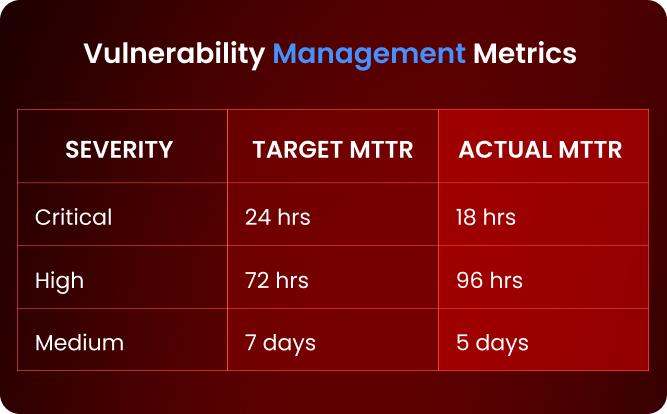
Mean Time to Remediate (MTTR) Vulnerabilities
One of the most actionable and revealing metrics in any cybersecurity program is Mean Time to Remediate (MTTR). It measures how quickly security teams can address discovered vulnerabilities.
Why it matters: Shorter MTTR means reduced window of exploitation. Longer MTTRs can signal resourcing issues, patch management gaps, or poor prioritization.
A solid vCISO should track:
- MTTR for critical, high, and medium vulnerabilities
- Average vs. target MTTR
- Backlog of unresolved vulnerabilities
Patch Management Compliance Rates
Patching is a foundational control and a frequent weak point. Tracking patch compliance across servers, endpoints, and cloud environments shows how well the organization adheres to its patching SLAs.
Key indicators:
- Percentage of systems fully patched within SLA
- Exceptions due to operational constraints
- High-risk systems with delayed patching
This data helps prioritize remediation and improve coordination between security and IT operations.
Threat Intelligence and Incident Metrics
Number of Detected Incidents per Month
Keeping track of the number of security incidents detected over time provides a high-level view of your threat environment. A rising trend might indicate increased targeting, better detection, or both.
Key considerations:
- Segmentation by severity (low, medium, high)
- Incident type (e.g., phishing, malware, insider threats)
- Trends over time (monthly or quarterly changes)
This helps leadership understand the scale of threats being faced and the workload on security teams.
Dwell Time Before Detection
Dwell time refers to the period between when an attacker gains access and when they are discovered. It’s one of the most telling indicators of detection maturity.
A lower dwell time means attackers have less opportunity to move laterally, exfiltrate data, or cause damage. According to IBM, organizations that implemented robust security automation reduced breach lifecycle by an average of 108 days.
Track:
- Average dwell time across incidents
- Comparison to industry benchmarks
- Time to containment vs. time to detection
Reducing dwell time should be a top priority in any threat detection strategy.
False Positive and False Negative Rates
Detection tools are only as good as their accuracy. Too many false positives (alerts for benign activity) can overwhelm analysts and lead to alert fatigue. False negatives, on the other hand, are undetected threats far more dangerous.
A vCISO should report:
- Percentage of alerts classified as false positives
- Known incidents missed by detection systems (false negatives)
- Improvement over time through tuning or better tooling
This helps justify investments in better threat intelligence or managed detection and response (MDR) services.
Security Awareness and Training Metrics
Phishing Simulation Success/Failure Rates
Human error remains a top attack vector, and phishing simulations are one of the most direct ways to measure employee's susceptibility.
Track:
- Click-through rates on simulated phishing emails
- Reporting rate of phishing attempts (real and simulated)
- Repeat offenders vs. first-timers
Over time, these metrics should show improvement, helping you tailor training to at-risk departments or roles.
Employee Training Completion Rates
Security awareness training is only effective if people actually complete it. This KPI is simple but essential.
Useful breakdowns include:
- Overall completion rate
- Completion by department or role
- Frequency of training (annual, quarterly, etc.)
Ideally, this data should be integrated with HR and performance systems so that security becomes part of the org’s DNA, not an annual checkbox.
Access Control and Identity Metrics
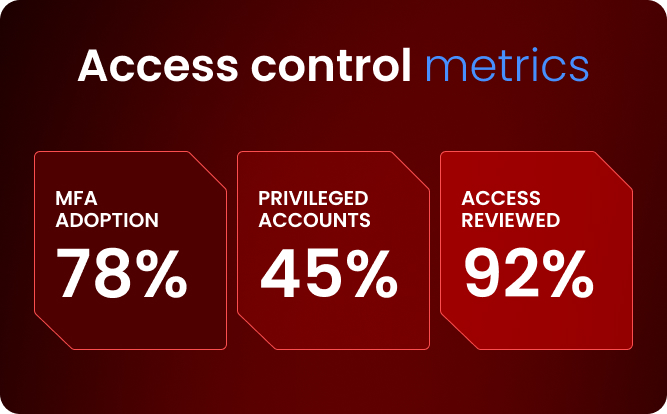
Privileged Account Monitoring Statistics
Privileged accounts are often the crown jewels for attackers. Monitoring and managing these accounts are essential to reduce the blast radius of a potential breach.
Metrics to track:
- Number of privileged accounts
- Privileged access reviews completed vs. overdue
- Instances of privilege misuse or escalation attempts
This data supports identity governance and can trigger process improvements or access minimization initiatives.
Multi-Factor Authentication (MFA) Adoption Rates
MFA remains one of the most effective controls to prevent account compromise, yet adoption gaps still exist especially with legacy systems or third-party tools.
vCISOs should report:
- Percentage of users covered by MFA
- MFA coverage by system type (internal, external, cloud)
- Trends in adoption after rollout initiatives
This is a strong indicator of basic security hygiene and is often scrutinized in audits and assessments. Microsoft reports that MFA can prevent 99.9% of account compromise attacks, making its adoption a measurable and high-impact KPI.
Endpoint and Network Security Metrics
Endpoint Protection Coverage
Endpoints like laptops, desktops, mobile devices are where attacks often begin. Ensuring comprehensive and consistent endpoint protection across the enterprise is foundational.
vCISOs should track:
- Percentage of endpoints with active security agents (EDR, AV, DLP)
- Devices reporting real-time telemetry
- Number of unmanaged or unprotected endpoints
The goal is to identify blind spots and ensure coverage across remote workforces, hybrid infrastructures, and BYOD environments.
Network Segmentation Compliance
Network segmentation helps limit lateral movement once a threat actor breaches an environment. Yet, poor segmentation can undermine an otherwise solid security posture.
KPIs in this area include:
- Percentage of critical systems segmented from public or internal traffic
- Firewall rule changes vs. approved segmentation policies
- Incidents tied to segmentation violations
These metrics help demonstrate architectural maturity and reduce the risk of widespread compromise.
Third-Party Risk Metrics
Vendor Security Assessment Scores
Third-party vendors and service providers often have access to sensitive systems or data. Measuring vendor risk is essential to avoid supply chain attacks.
vCISOs can track:
- Percentage of vendors assessed using standardized security frameworks (e.g., SIG, CAIQ)
- Average risk score across active vendors
- Number of high-risk vendors in production
Third-Party Incident Counts
According to IBM’s 2023 Cost of a Data Breach Report, 82% of organizations experienced at least one data breach originating from a third-party vendor. Monitoring how many incidents originate from third-party relationships helps spotlight weak links.
Examples:
- Number of security incidents involving vendors per quarter
- Time to notify and remediate third-party-related issues
- Vendors with recurring compliance violations
These metrics often surface in board conversations and audits, especially in highly regulated industries like finance or healthcare.
Business Continuity and Incident Response Metrics
Recovery Time Objective (RTO) and Recovery Point Objective (RPO)
These two KPIs are vital to understanding the organization's ability to recover from disruption:
- RTO (Recovery Time Objective): Maximum acceptable downtime for systems or processes
- RPO (Recovery Point Objective): Maximum tolerable data loss (in time)
vCISOs should track:
- Percentage of systems meeting defined RTOs/RPOs
- Gap between current recovery capability and business expectations
- Time to execute actual recoveries during testing or incidents
These numbers guide BCDR investments and help quantify business risk in technical terms.
Incident Response Plan Testing Frequency and Results
Having an incident response (IR) plan is table stakes testing; it is where maturity shows.
Track metrics such as:
- Number of IR plan tests performed annually
- Test outcomes (e.g., time to detect, escalate, respond, and recover)
- Lessons learned and improvements implemented post-exercise
These KPIs validate readiness and reinforce executive confidence in the organization’s ability to handle crises.
Cost and Resource Metrics
Security Spend vs. Budget
Understanding how much is being spent on cybersecurity and whether that spending aligns with the organization’s risk profile is a foundational responsibility for a vCISO. This isn’t just about dollars spent, but about efficiency and strategic alignment.
Key metrics include:
- Total security spends as a percentage of IT or overall budget
- Budget variance (actual spend vs. planned)
- Investment breakdown (tools, personnel, consulting, training)
This data helps the vCISO demonstrate fiscal responsibility and justify future investments with the board or CFO.
Cost per Security Incident
This is a critical but often overlooked KPI: How much does each incident cost the business? By assigning an average cost to containment, investigation, downtime, and recovery, the organization can better appreciate the true impact of insufficient controls.
Common cost factors include:
- Time spent by staff (internal or third-party)
- Revenue loss from downtime or breach
- Fines, legal fees, or brand damage
Tracking this over time helps reveal ROI on preventative measures and highlights the value of early detection and response.
Board-Level and Executive Reporting
KPIs Most Relevant to the C-Suite
Board members and executive leaders don’t want technical details they want business impact. A successful vCISO filters complex data into clear, strategic insights that support decision-making.
The most relevant KPIs for leadership typically include:
- Risk exposure levels and trends
- Compliance status and audit outcomes
- High-severity incident summaries
- Time to detect/respond
- Security maturity benchmarks compared to peers or standards
The vCISO's role here is not just to present data but to provide context, risk framing, and actionable recommendations.
Tailoring Metrics for Non-Technical Leadership
Metrics lose meaning if the audience doesn’t understand them. A seasoned vCISO tailors reports to fit executive language, often translating technical KPIs into:
- Business risk ratings (e.g., revenue impact, operational disruption)
- Heat maps or dashboards for visual clarity
- Simple trend lines and what they mean for business continuity
This ensures that cybersecurity is seen not as an IT function but as a business enabler.
Challenges in Measuring Cybersecurity Performance
Common Pitfalls and How to Avoid Them
Tracking the wrong metrics or tracking too many can dilute focus. Here are a few frequent mistakes:
- Focusing on vanity metrics (e.g., number of alerts) rather than actionable KPIs
- Using inconsistent definitions across teams or tools
- Failing to validate data accuracy or context
Avoiding these requires consistent KPI governance, strong documentation, and buy-in from both security and business teams.
Striking the Balance Between Simplicity and Technical Detail
One of the hardest parts of reporting is finding the right level of detail. Too simple, and it lacks credibility. Too complex, and it loses your audience.
vCISOs succeed when they:
- Build layered reporting, where summaries link to deeper technical breakdowns
- Use automated dashboards for real-time tracking
- Translate security metrics into risk and business outcomes
This balance builds trust and drives more informed decision-making at every level of the organization.
Conclusion
Tracking cybersecurity metrics is not just a technical exercise; it’s a leadership imperative. For vCISOs, the ability to measure, communicate, and drive action through KPIs is what separates tactical security operations from strategic business enablement.
The right metrics help build trust across the organization, from engineers to the executive suite. They shine a light on where the risks are, where progress is being made, and where attention is urgently needed. Whether it's reducing dwell time, improving patch compliance, or aligning with regulatory frameworks, measurable outcomes drive smarter decisions.
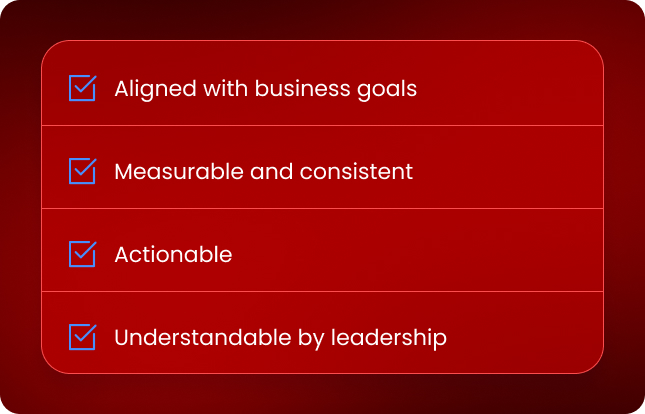
Ultimately, a metrics-driven vCISO is better equipped to champion a security culture that is resilient, agile, and aligned with business goals. By focusing on the KPIs that matter most and presenting them in the right context, vCISOs can lead with clarity and influence at the highest levels.
FAQs
1. What’s the difference between a CISO and a vCISO?
A CISO is a full-time executive employed by an organization, while a vCISO is typically a contracted or part-time security leader. vCISOs offer strategic oversight and security program development without the cost of a full-time hire, making them ideal for small to mid-sized businesses or startups.
2. How do vCISOs determine which KPIs to track?
vCISOs align KPIs with the organization’s business goals, risk profile, compliance requirements, and maturity level. They also consider what metrics will be most effective in communicating risk and performance to stakeholders.
3. What tools help vCISOs track and report security metrics?
Common tools include SIEM platforms, vulnerability scanners, compliance dashboards, threat intelligence feeds, and GRC platforms. Many vCISOs also use business intelligence tools like Power BI or Tableau to create executive-friendly dashboards.
4. How often should security metrics be reviewed?
It depends on the metric. Some should be tracked in real-time (e.g., incident detection), while others can be reviewed monthly or quarterly (e.g., compliance status, training completion). Board-level metrics are typically reviewed quarterly.
5. Can tracking too many metrics become counterproductive?
Absolutely. Too many metrics can dilute focus and overwhelm stakeholders. The key is to prioritize quality over quantity tracking the most meaningful KPIs that drive action, not just activity.
SUMMARIZE WITH AI
.png)

.png)