AI Red Teaming Services for Real-World Adversarial Resilience

Ebryx tests LLM applications, RAG pipelines, AI agents, models, and the infrastructure around them against realistic adversarial objectives. We uncover how attackers could manipulate behavior, expose sensitive data, abuse tools, or move from an AI interface into connected systems, then give your team a clear path to reduce the risk.

Schedule an AI Red Teaming Consultation
Secure, Compliant & Resilient Cloud Security Services

When AI Can Act, the Attack Surface Changes

AI systems now retrieve internal knowledge, call APIs, write code, trigger workflows, and make decisions across business processes. A weakness in a prompt, retrieval source, agent permission, or downstream integration can become a path to data exposure, fraud, unauthorized action, or service disruption.

Conventional application testing still matters, but it does not fully assess how an AI system interprets instructions, combines context, uses tools, or behaves across multi-step interactions. Ebryx AI Red Teaming applies an attacker's mindset to the complete AI ecosystem so your team can see which scenarios are genuinely exploitable and what to fix first.

Find the Weak Links Across Models,
Data, Agents, and Integrations

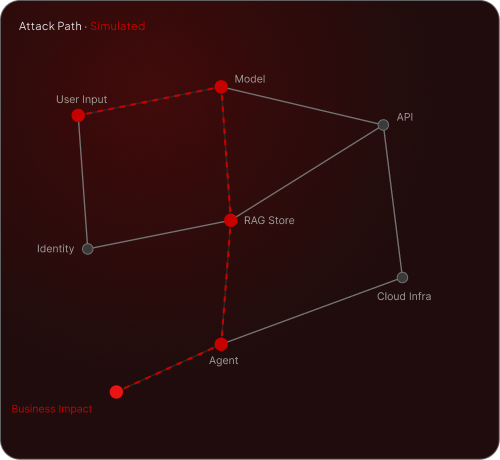
AI risk rarely sits in one component. We test the connections between models, retrieval systems, identities,
tools, APIs, data stores, and cloud infrastructure to identify attack paths that isolated checks can miss.

01

Prompt Injection and Guardrail Bypass

Test whether direct or indirect instructions can override intended behavior, reveal protected context, or steer the system toward unsafe actions.

02

Excessive Agency and Tool Misuse

Assess whether an AI agent can exceed itsauthority, invoke sensitive tools, or completehigh-impact actions without adequatechecks.

03

RAG and Knowledge-Base Manipulation

Probe retrieval sources, embeddings, andcontext assembly for poisoning, maliciousinstruction retrieval, and unauthorized accessto protected knowledge.

04

Sensitive Information Disclosure

Look for paths that expose system prompts,credentials, personal information, proprietary data, or confidential business context through model responses or connected services.

05

Agent-to-Agent Trust Failures

Evaluate how instructions and data move between autonomous agents, including whether one compromised agent can manipulate another or bypass internal controls.

06

Model and Data Extraction

Test for model extraction, membership inference, model inversion, and other techniques that could reveal intellectual property or sensitive training data.

Adversarial Testing Grounded in
How Your AI Actually Operates

Ebryx combines offensive security, AI security research, application testing, and threat modeling to
evaluate the full path from manipulated input to business impact. Each engagement is scoped around your
architecture, risk profile, and operating constraints.
Plan your AI Red Teaming Engagement

Objective-Led
Simulation

We begin with outcomes an attacker would pursue, then build realistic attack pathsaround your AI use cases and exposed workflows.

End-to-End
Ecosystem Coverage

Testing can span the model, prompts, RAG layer, agents, APIs, identities, cloud services,and downstream applications within the agreed scope.

Manual Research With
Targeted Automation

Our team combines expert-led adversarial testing with repeatable tooling to exploreboth known AI risks and system-specific failure modes.

Controlled,
Authorized Execution

Rules of engagement, test boundaries, safety controls, and escalation paths are agreedbefore testing begins.

Actionable
Remediation

Findings connect technical evidence to business impact, ownership, and prioritizedfixes your engineering and security teams can execute.

Go Beyond Isolated Findings
to See the Full Attack Path

Both approaches have value, but they answer different questions. The right choice depends on whether
you need focused vulnerability discovery or a broader simulation of how an adversary could achieve a
defined business objective.

AI Penetration Testing

A focused assessment of a defined AI application, model, API, or control. The goal is to identify and validate technical weaknesses within a bounded scope at a point in time.

AI Red Teaming

Objective-based AI ecosystem simulations that chain weaknesses across models, retrieval, permissions, identities, APIs, and infrastructure to demonstrate business impact.

Test the Whole AI Ecosystem,
Not Just the Prompt

Our testing adapts to your architecture, whether you are deploying a customer-facing assistant, internal
copilot, RAG application, autonomous agent, multi-agent workflow, or AI-enabled security product.

LLM Application and Prompt Security

Evaluate direct and indirect promptinjection, jailbreaks, system promptleakage, unsafe output handling,instruction hierarchy failures, and cross-session data exposure.

AI Agent and Tool-Use Security

Test delegated authority, tool permissions,human approval gates, memory, sessionboundaries, confused-deputy scenarios,and unauthorized actions acrossconnected services.

RAG and Knowledge Pipeline Security

Assess retrieval authorization, vector andembedding weaknesses, data poisoning,malicious document ingestion, contextmanipulation, and sensitive knowledgeexposure.

Model, API, and Data Abuse

Probe for model extraction, membershipinference, model inversion, rate-limitbypass, resource exhaustion, insecuremodel endpoints, and leakage fromtraining or fine-tuning data.

AI Ecosystem and Infrastructure

Review the security of model gateways,plugins, APIs, identity flows, cloud services,secrets, logging, and downstreamapplications that determine the system'sactual blast radius.

Safety and Trust Validation

Challenge safeguards related to harmfuloutputs, policy evasion, misinformation,bias, brand risk, and other misuse scenariostied to your business context.

Simulate the Attacks That
Matter to Your Architecture

Every engagement uses approved scenarios based on the system's capabilities, data sensitivity, user
roles, and downstream access. Examples include:

Agentic Loop Hijacking

Manipulating an autonomous workflow so the agent repeatedly calls tools, ignores limits, or completes anunauthorized objective.

Indirect Prompt Injection
and RAG Poisoning

Placing malicious instructions in retrieved content to influence the model or hijack a user's session.

Agent-to-Agent
Manipulation

Exploiting trust between agents to pass malicious instructions, evade controls, or move sensitive data.

Sensitive Data Exfiltration

Using prompts, context manipulation, tool calls, or inference techniques to extract protected data or intellectualproperty.

Prompt-to-Code Execution

Testing whether model output or tool use can reach command execution, unsafe automation, or otherdownstream compromise where the architecture permits it.

Unbounded Consumption
and Denial of Wallet

Triggering excessive token use, repeated tool calls, or resource-heavy workflows that create service disruption orunexpected cost.

A Controlled Path From Discovery
to Hardening

Each engagement follows a structured lifecycle designed to protect operations while producing evidence
your technical and executive teams can use.
1
1 month

Reconnaissance and Asset Mapping

Identify approved AI assets, model versions, prompts, RAG data stores, agents, APIs,identities, third-party dependencies, and shadow AI exposure within scope.

2
2 months

Adversarial Threat Modeling

Define attacker personas, business-risk scenarios, success criteria, and technical attackpaths based on how the system is used.

3
3 months

Controlled Adversarial Execution

Conduct manual and tool-assisted testing against agreed scenarios, includingjailbreaks, injection, poisoning, data exposure, and agent abuse.

4

Impact and Lateral Movement Validation

Determine whether a successful AI compromise can reach internal data, cloud services,privileged tools, downstream applications, or other agents.

4

Reporting, Executive Review,
and Hardening

Present the attack narrative, explain business impact, prioritize remediation, andvalidate fixes through retesting when included in scope.

Technical Rigor With Risk
Context Leaders Can Use

Ebryx maps testing and findings to recognized AI security and risk-management frameworks. This creates
a repeatable coverage model and helps teams connect adversarial evidence to engineering, governance,
and assurance programs.

MITRE ATLAS

Maps adversarial tactics and techniques across the AI attack lifecycle and supports clear attack-path reporting.

OWASP Top 10 for LLM and GenAI Applications

Systematically tests prompt injection, data leakage, supply-chain risks, model poisoning, improper outputs, excessive agency, prompt leakage, vector weaknesses, misinformation, and unbounded consumption.

NIST AI Risk Management Framework and GenAI Profile

Helps frame technical findings withinbroader governance, mapping,measurement, and risk-managementactivities.

Evidence, Attack Narratives, and
a Practical Hardening Roadmap

Your final package is designed for both decision-makers and the teams responsible for remediation.

Executive Summary Report

A concise view of the most important AI risks,credible business impact, and decisionsrequiring leadership attention.

Adversarial Attack Narrative

A step-by-step account of successful attackpaths, control bypasses, affectedcomponents, and the resulting blast radius.

Technical Findings Pack

Evidence, reproduction guidance, severity,affected assets, preconditions, and root-cause analysis for each validated finding.

Remediation and Hardening Roadmap

Prioritized technical and architectural actionsorganized around impact, effort,dependencies, and responsible teams.

Coverage and Framework Mapping

A record of scenarios tested and theiralignment to relevant MITRE ATLAS, OWASP, and NIST categories.

Retest Results

Validation of agreed fixes and residual risk when remediation testing is included in the engagement.

Test Before Launch, After Change,
or Against a Defined Threat

Pre-Launch Readiness

Challenge a new AI applicationor agent before customers,employees, or partners dependon it.

Post-Change Validation

Retest after a model change,new tool integration, RAG update, fine-tuning cycle, orarchitecture redesign.

Objective-Based Simulation

Evaluate a defined concernsuch as data exfiltration, fraud,unauthorized action, modeltheft, or access to internalsystems.

Remediation Validation

Confirm that guardrails,permissions, filtering,monitoring, and architecturalfixes hold up under adversarialpressure.

AI Security for High-
Consequence Environments

Financial Services andFinTech

Test AI-enabled fraud controls,customer assistants, decisionworkflows, document processing,and systems that interact withsensitive financial data.

Healthcare

Assess AI applications that handleprotected health information,support clinical or operationalworkflows, or connect toregulated data systems.

SaaS and Technology

Challenge embedded copilots,customer-facing assistants,developer tools, AI-enabledproducts, and multi-tenant databoundaries.

Government and CriticalServices

Evaluate AI deployments whereunauthorized action, dataleakage, service disruption, orsupply-chain compromise couldcreate mission impact.

FAQs

Stop Threats Before They Become Incidents 

Put Your AI Under Pressure Before an Attacker Does

Talk to Ebryx about an AI red team engagement tailored to your models, agents, data, integrations, and business-critical workflows.
Schedule an AI Red Teaming Consultation
Futuristic blue robot with glowing orange lock icons and digital circuit patterns on its body.